On ‘Two’ by Satyajit Ray: In 1964, renowned filmmaker Satyajit Ray was asked to create a short film for Esso World Theater, a cultural showcase presented on television and funded by the American oil company Esso. ‘Two’ was made as part of a trilogy of short films from India commissioned by US Public Television. The other two films in the trilogy featured Pandit Ravi Shankar and a ballet troupe from Bombay.
Ray was asked to make a film in English in a Bengali setting. Not very happy with the prospect, he opted to do away with the spoken word entirely. Asked to write and direct the film in English, Ray opted instead to make a film without words. The result is a fable of friendship and rivalry.
Advertisement
‘Two’ is often considered a prelude to the much acclaimed film ‘Goopy Gyne Bagha Byne’ (1969). It is perhaps also a tribute to the director’s favourite genre of silent movies.
The crew and cast
Soumendu Roy did the cinematography. Editing credit goes to Dulal Dutta. Ray himself composed the music. The two actors were Ravi Kiran and Babu Biswas. The film ran for 12 minutes and was shot in black and white with no dialogue.
Ray made the film in the same year as his masterpiece ‘Charulata’. It was one of only two fictional short films by him in his entire career. The better known of the two fictional shorts is ‘Pikoo’ (1980), which explores a young boy’s world against a backdrop of adults in crisis.
The story
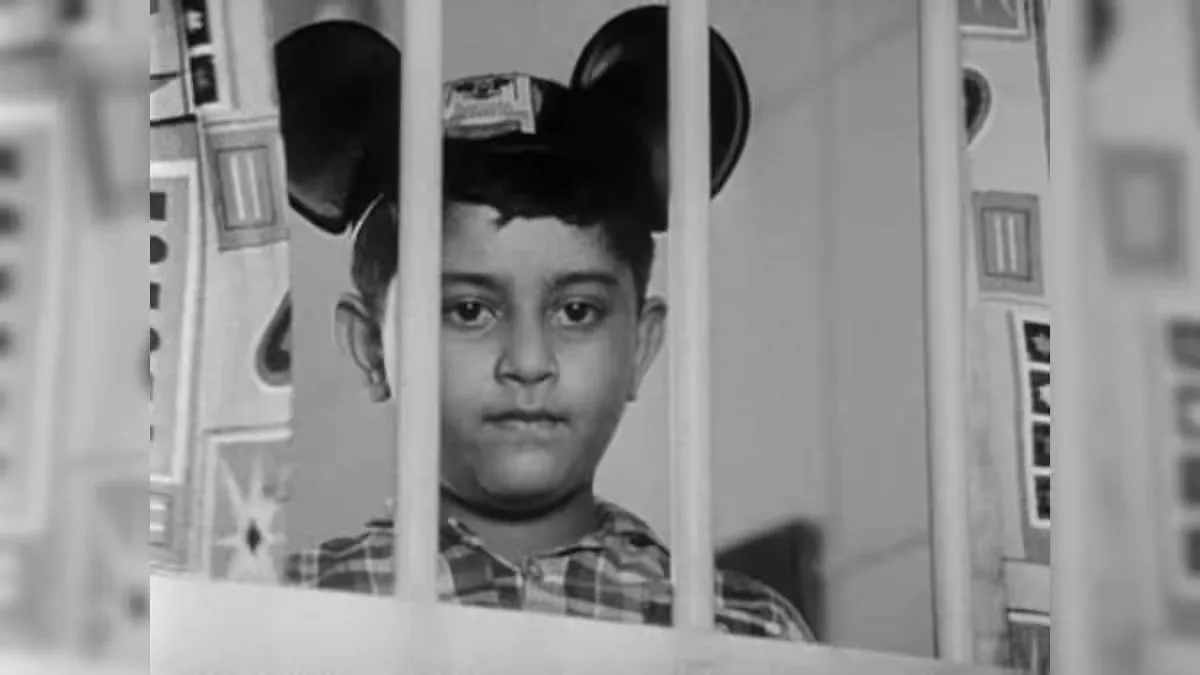
‘Two’ features two boys in the absence of adults. One is plump and privileged, while the other is lean and poor.
The film begins on a lonely, lazy afternoon with a young boy lazing around his empty mansion, sipping a cola and watching a vehicle from his balcony. The young boy, dressed rather affluently for the period, wanders aimlessly and bursts balloons with matchsticks.
When the rich boy hears a flute being played by the boy from the shanty underneath his building, it sets off a war of toys. Each boy displays his playthings in an attempt to outdo the other.
The film has no dialogue and the action moves through attempts at one-upmanship through their successive display of toys. Their rivalry includes a kite shot down by a toy rifle. The contest concludes with the opposition between the world of noise from the toys inside the house and the world of music from the street child’s flute.
Towards the end, both children retreat to their respective abodes.
The class commentary
The film stages a seemingly simple rivalry between two children. One is affluent, playing inside a modern urban home. The other is down and out, playing on the streets outside.
The short film addresses lack of empathy, socio-economic divide, class divide, happiness, and the human tendency to drag the other down. All of this with no dialogues and just two kids in the frame.
The physical positioning of the two boys reinforces the division throughout. The rich boy is inside an apartment with consumer goods surrounding him. The poor boy exists in the open, in the grass, near a hut, with only natural objects and a handmade flute. The film captures childlike rivalry, but nothing is innocent about it. It echoes the often-ignored gap created by socio-economic factors.
The competition that brews up between the two children is almost playful, except that it is not what it appears to be at face value. The rich boy has a toy gun, a toy car, a rocking horse and mechanised playthings. Each time the poor boy produces something of his own, the rich boy responds by deploying something louder, bigger and more expensive. The moment the kite belonging to the street child floats up in the air, the rich boy shoots it down with his toy rifle.
Sound over silence
The film uses sound as a primary storytelling device. The rivalry concludes with the opposition between the world of noise produced by the toys inside the house and the world of music from the street child’s flute.
Ray composed the music for the film himself, including the haunting tune played on the flute. This is significant. The only thing the poor boy has that the rich boy cannot replicate or destroy is music. The flute, a simple instrument, ultimately outlasts the noise of expensive toys.
Experts believe that the film ends with the street kid’s flute sound overpowering the sound of expensive toys.
The Vietnam War context
The film came out at the time of the Vietnam War. There are no explicit depictions of it, but there are subtle allusions. The film is a commentary on class divide and socio-economic struggles in post-colonial India, mirroring global struggles against imperialism during the Vietnam War.
Experts believe the film makes a strong anti-war statement, as it ends with the street child’s flute sound overpowering the noise of expensive toys.
The basic idea of states tending to one-up each other in an anarchical international system comes out through the two young kids doing the same, using their objects as a show of power.
Preservation and legacy
The Academy Film Archive, part of the Academy Foundation, took an initiative to restore Satyajit Ray’s films. It could successfully restore 19 Ray films.
Ray received a Lifetime Achievement Oscar in 1991 for his body of work, starting with ‘Pather Panchali’ in 1955. The filmmaker was severely ill when he received the award and died the following year.
‘Two’ did not get the audience at that time, but it stands as one of Ray’s most prolific works.